I have talked about my regimen before in
this post, however things have changed a little bit since then so I figured I should update you all. I feel this might also answer questions for ladies who ask me where to start, because after experimenting with a load of different methods, I begin every session this way now, regardless of how I am going to end up styling (be it a twistout, braidout, twists, braids, etc).
I have settled into the routine of washing my hair once a week. I tend to do this midweek in the evening after work, so that I can have nice fresh hair for the weekend. I also now shampoo every week, which I wasn't doing when I began my "healthy hair journey", as at that time I was still struggling with moisture issues. These days I tend to save cowashing for if for some reason I decide to do a second (or 3rd) wash during the week, for e.g. if I have been working out a lot, or swimming, if I know I will not get a chance to deep condition my hair (this is rare, but happens at times like when I am travelling and don't have a lot of time to devote to my hair), if I am washing a protective style (for e.g. if I am in mini-twists, which I tend to keep in for at least 2 weeks) or if I just feel like a style has not been working and I want to do something different. But for the most part, now that I have sorted out my moisture balance, my hair seems to like a weekly shampoo. And I always follow up with a deep conditioner. As I believe I may have mentioned, I have read several articles and blog posts that mention deep conditioning is unnecessary, however I definitely notice a difference in my hair when my conditioner has been left on for longer (at least an hour). So again, different things work for different people.
Once in a while, once a month if I remember, I will do a special treatment, such as a protein treatment, henna (which I have just begun to revisit after a 1 year hiatus), bentonite clay wash or some sort of ayurvedic treatment. I will delve into these in more detail in future posts, but for now, here's what my average wash day looks like.
Step 1
I decide whether I am going to deep condition before or after I shampoo. I have heard arguments for both methods. Some people say deep conditioning on dry hair is best, because when the hair strands are not full of water they can soak in more conditioner. I have absolutely no idea if this is true, and to be honest I don't see a difference either way. However I prefer to apply my DC on dry hair before I wash solely because it is more convenient. I hate having to get in the shower multiple times during the course of a wash, so this method means I can come home from work, go straight to the mirror without even having to undress, slap on my condish, cover with a plastic cap and go about my business. I only wash first if I feel my hair is particularly dirty, like if too many random strangers have managed to get their hands into it since the last wash, or if I have been caught in a sandstorm, for example (this has happened much more often than would seem likely).
I tend to deep condition with Aubreys Organics Honeysuckle Rose Conditioner for the most part (usually adding a bit of honey and olive oil to the mix), alternating with Aubreys Organics GPB every 2 or 3 weeks. I do this because my hair craves protein, but again, I will go into detail on this in a later post.
Step 2
I begin by sectioning my hair into 4. It has become impossible to wash my hair in one loose mass now, unless I want to revisit the 3 hour detangling sessions of yore. I only wish I had figured this out much earlier, it might have saved a lot of heartache.
If I am doing the DC first, I apply it to each section, gently detangling my hair with my fingers and separating any knots I come across. When that section is completely covered in my conditioner, I braid it up and then move to the next until all 4 sections are done.
I then cover with a plastic cap, and go under my hooded dryer for a
few minutes to open the cuticles. Then I cover with a towel to trap in
my body heat, and do whatever I need to do: dinner, work, etc. I tend to
leave my DC's in for at least an hour, and have been known to leave
them in overnight (although this is not advisable for everyone, as some
people might experience over-moisturised hair. This has never been the
case for me).
If I plan to shampoo my hair first, I
work in the same 4 sections, but I gently finger-detangle with coconut
oil instead. I leave this on for a few minutes as a pre-poo treatment
(coconut oil is said to prevent too much water entering the hair shaft
and causing
hydral fatigue. This is the only time I can use it on its own. Generally my hair can't stand plain coconut oil.)
 |
| Sectioned hair with coconut oil pre-poo |
Step 3
Then I hop in the shower, undo one of the sections and apply my shampoo. I always start at the front so that the dirty water when rinsing runs into the unwashed sections at the back, which will be washed eventually. I was using Giovanni Smooth As Silk Shampoo, but have just switched to the Elucence Moisture Benefits Shampoo, which I absolutely love. I hold the section of hair at the tip so it doesn't tangle and knot, and apply the shampoo to my scalp, and the parting between the sections, rubbing with the pads of my fingers, and never my nails. (Scrubbing your scalp with your nails can damage your hair follicles). I squeeze the section to distribute the shampoo through my hair, and smooth it down the length of my hair, as always not allowing the section to tangle.
I usually then apply a little bit of conditioner over my shampoo before I rinse it out in a downwards motion, as this helps prevent the stripped feeling that can come from shampooing.
Step 4
If I have already deep conditioned before shampooing, I take a bit of my detangling conditioner, usually whatever conditioner I use as my cowash conditioner (at the moment it is the Elucence Moisture Balancing Conditioner or Tresemme Naturals. Pretty much any cheapie conditioner will do). I divide the section of my hair into 3-5 smaller sections, and comb through the conditioner with a wide toothed comb. Then I clip that section out of the way and begin to work on the next section, until all 4 quarters of my hair are washed, detangled and twisted. Then I rinse the conditioner out of my whole head with my hair still in twists. This way, I never allow my hair to tangle up, combing is no longer a problem, and I am normally able to detangle and twist my entire head within 30 minutes.
If I didn't deep condition before, this is the point at which I do. As above, I apply my DC making 3-5 smaller sections as I go along, and gently detangle with a wide toothed comb before I twist it up, and then move on and do the same for the other 3 quarters of my hair. I find that the Aubreys Organics Honeysuckle Rose does not have much slip on its own, so is not very easy to detangle with. Adding olive oil helps with this problem considerably. Once my DC has been applied to my whole head, and I have detangled and twisted, I cover with a plastic cap, use heat for a few minutes, then cover with a towel as before. Once it has been in for a while (again anything from one hour to overnight), I rinse my entire head without undoing the twists.
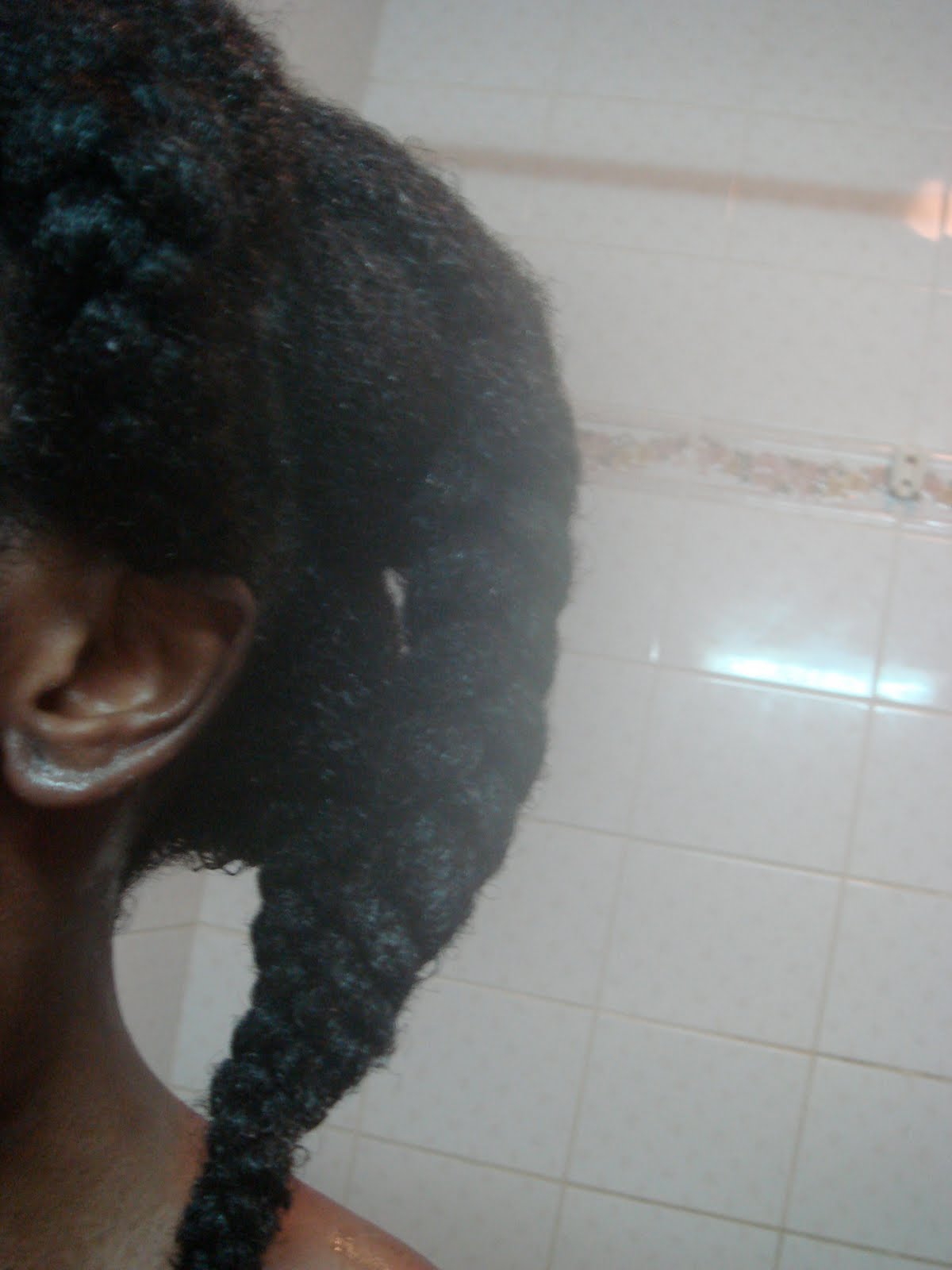
This step is quite messy, so I have not been able to get any pictures of it, but as I work in the same twists from here until the end of my routine, the pictures in the next step show roughly how many, and how big they are.
Step 5
Once out of the shower, with my hair rinsed, I squeeze some of the water out using a t-shirt, since conventional towels can cause unnecessary frizz. Then I apply my leave-in conditioner, making sure to rake it through with my fingers so I can cover as much of my hair as possible. Sometimes I undo each twist, sometimes I just apply my leave-in to the twists, squeezing it in so it penetrates them. Then I seal with either my shea butter and oil mix, or the Kinky Apothecary Whipped Shea Batter, retwist and leave it to dry. They don't have to be tidy and in fact very rarely are, as they are not a style but just a drying aid.
 |
| I noticed long after that I was only wearing one earring. These pictures show that I lost the other one right at the start of the process. Sigh. |
Once my hair is about 80% dry (either a couple of hours later if I didn't DC overnight, or at the end of the next day if I did, and then rinsed and applied my leave-in the next morning), I undo, apply whatever product I am going to use (normally a gel if I am doing a braidout or twistout, or some Whipped Shea Batter if I am just going to be wearing smaller twists), and then style.
This is another difference between my current method and my old regimen. I am normally in a braidout, twistout or twists, and used to style on soaking wet hair, but it would take forever- days in fact- to dry when I did it that way. Allowing my hair to dry in twists before means that when I style, my twistout or braidout normally sets overnight or in a few hours. They are not as defined, and do not hold as long as when they are done on wet hair, but I quickly became sick of having my hair drip all over my clothes all day, and so I altered the way I went about it.
I just find creative ways of pinning up my fat twists to make them look presentable for as long as I need to keep them in.
Styling on dry, already stretched out hair leads to less shrinkage and
longer, fuller-looking braidouts, twistouts and even twists, and I'll
describe how I go from fat twists to these styles in the next post.
Some tips for coming up with your own regimen
I really can't stress enough how important it is to
come up with your own hair care regimen. It helps to understand your hair and having a routine can help to eliminate
frustration. Again, you have to bear in mind that different things
work for different people, and you have to experiment with different
methods and then find what suits you best.
I get so many people approaching me or writing to me to
say their hair is unmanageable. I used to think that about my hair too
but if we look at the things that make us consider our hair unmanageable
(1/ dryness and breakage, 2/ difficulty detangling, 3/ denseness), you
quickly realise that if you figure out how to deal with those issues one at a time, doing your hair becomes just a process, and less of a chore. Coming up with your own routine will help you figure out how best to do this for yourself.
Products
When I am asked by customers for product recommendations and where to start, I always explain that there is no set product that will achieve this or that for everybody. The important thing is to ensure that you understand the ingredients so you quickly figure out which ones may be detrimental to your hair in particular, and therefore should be eliminated, but also what ingredients your hair loves so that you can try and incorporate them as much as possible.
The basics to begin with are a good cleanser (either a cowash conditioner or a good moisturising shampoo), a deep conditioner, a leave-in, and a sealant. These are just the basics. Obviously depending on how you want to wear your hair, stylers are also important (i.e. gels, puddings, etc). People with drier hair may need to follow up the leave-in with a moisturiser before sealing. I used to have to do this. Some products can perform multiple functions (e.g. the Elucence Moisture Balancing Conditioner can be a cowash, a detangling conditioner, a deep conditioner and a leave-in. Most leave-in conditioners can be used as light moisturisers and vice versa)
It is all about experimenting, and of course you can try as many as you want, or you can keep it simple, figure out basics that you love and stick with them.
I test out many, all in the name of business (I know. It's a tough life!) but I do have my staples that I come back to. Our range is expanding considerably over the next month, so there will be a much larger variety to choose from, however once you find what works for you, it is best to stick with that and not be tempted to jump from brand to brand...although that IS a lot of fun.
Sections
Working in sections allows me to break up the task so it doesn't seem so daunting. Also my hair is braided and twisted for much of the process, and is never allowed to tangle, thereby eliminating long painful combing sessions.
Stretching
For me (and most people with kinky and tightly-curled hair) it is very important to keep my hair stretched, so the focus of my wash days are to get my hair clean, and stretched out without heat. Hence the fat twists. But other methods of doing this are braiding, banding, threading (like we used to do as kids but forgot about as we grew up), etc. Figure out what method you prefer and work with that.
Breaking up the process
Another thing that has helped is that I now break the process up into stages. Sometimes it is nice to have long hair spa days, but these days I am always so busy, I rarely have the time for this. As I alluded to earlier, I can typically apply the deep conditioner one evening, leave it overnight, wash the next morning, twist, go about my day, and then style in the evening ready for the following day. That way I am not having to set aside 3 hours in one go. Once I figured out how to make my fat twists look semi-presentable, I was good to go.
Patience
The fact that I am saying this cracks me up, because I am one of the most impatient people I know. However, it really is important to try not to do your hair when you are in a rush, or frustrated as this can lead to you ripping your hair out, or causing more tangles and therefore breakage. Especially while detangling. I try and do as much as possible in front of the TV (although this applies mainly to the styling stage which I haven't really talked about in this post) as I find that if I am watching something and entertained, I am less likely to get bored and rush.
Practise makes perfect
You may have to try many different methods before figuring out what works best for you, but don't be discouraged by this. Keep going, and you will eventually get there.
Hope all this helps. Some things were quite hard to describe and I may not have been entirely clear, so let me know if you have any questions.
Until the next time!